If you’ve ever stood in a field, yard, or small construction site staring at a pile of gravel, a stack of firewood, or a small concrete slab and wondered, “Will a compact tractor lift that?”—you’re not alone. As a compact tractor supplier, this is one of the first questions I get from new buyers, and it’s not one with a one-size-fits-all answer. Lifting capacity for compact tractors depends on way more than just how “compact” the machine looks. It’s rooted in engineering, intended use, and how you actually attach and use implements—and getting it right means avoiding frustration, wasted time, or even damaged equipment before you make a purchase. Compact Tractors
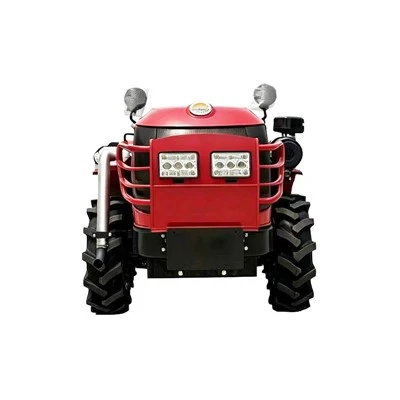
First, let’s break down what “lifting capacity” actually means for these small workhorses. Unlike full-sized farm tractors built for 10,000-pound bales or bulk material, compact tractors (defined here as tractors under 40 horsepower, plus some light 40–50 HP models built for residential and small commercial use) are designed for versatility, not brute force. Most buyers use them for tasks like moving hay bales, lifting pallets of landscaping stone, pulling a box blade for grading, or loading mulch into a truck bed. All of these rely on the tractor’s hydraulic lifting capacity, which is the maximum weight the tractor can safely lift with its three-point hitch (the standard attachment system for most implements) plus the load capacity of its front loader, the most popular attachment for lifting and moving heavy items.
Let’s start with the three-point hitch, because that’s the backbone of any compact tractor’s lifting ability. The three-point hitch is categorized into three standard classes: Category 0, Category 1, and sometimes Category 1N (N for narrow, for smaller tractors). For compact tractors, Category 0 is usually reserved for the smallest, sub-25 HP models, and Category 1 is the standard for most 25–50 HP compact tractors. The lifting capacity of a three-point hitch is measured in two ways: static lift (how much it can lift at the hitch pin, the point where implements attach) and lift height (how high it can raise that load off the ground). A common misconception is that a 30 HP compact tractor has a fixed lifting capacity—but that’s not true. For example, a sub-25 HP Category 0 compact tractor might have a three-point lift capacity of 500–800 pounds at the pin, while a 45 HP Category 1 model can hit 1,200–2,000 pounds. That range varies based on the tractor’s hydraulic system size, the size of its lift arms, and even its frame strength. Hydraulic flow rate also plays a role: a tractor with a higher gallon-per-minute (GPM) hydraulic system can lift a load faster and handle more consistent heavy loads than one with a smaller, slower system.
But here’s the part that surprises most new buyers: for lifting and moving bulky, ground-level loads, the front loader is where most of the action happens. A front loader is a dedicated attachment that mounts to the front of the tractor, with a bucket or forks to grab and move items like pallets, gravel, or brush. Loader lifting capacity is almost always higher than three-point hitch capacity, and it’s measured in two key specs: static lift capacity at full height, and breakout force, which is the amount of force needed to lift a load from the ground (critical for digging into a pile of mulch or lifting a heavy pallet that’s partially buried). For compact tractors, front loader capacity ranges wildly. The smallest 20–25 HP tractors might have loaders with a breakout force of 1,000–1,800 pounds and a lift capacity of 800–1,500 pounds at full height. Mid-range 30–40 HP compact tractors typically have breakout forces of 1,800–2,800 pounds and lift capacities of 1,500–2,200 pounds. Larger compact tractors, around 45–50 HP, can have breakout forces over 3,000 pounds and lift capacities up to 3,000 pounds at full height. That’s a big jump, and it’s why choosing the right size tractor for your loader needs is non-negotiable.
Now, I know what you’re thinking: “That sounds great, but can I trust those numbers? Should I add extra weight on the forks or bucket?” The short answer is no—those specs are the maximum safe load, and exceeding them puts you at risk of tipping the tractor, damaging hydraulic lines, or even bending the frame. Compact tractors have a lower center of gravity than full-sized tractors, but they’re still susceptible to tipping if you overload the front loader, since that weight is out in front of the wheels where you have the least traction and stability. A common rule of thumb I share with customers is to never lift more than 80% of the published maximum loader capacity. That extra 20% is a safety buffer for uneven ground, sloped yards, or loads that shift as you lift, which are all common in real-world work.
Let’s put this into real-life examples so it’s not just numbers. If you’re a homeowner with a 1/4-acre yard, you probably need a compact tractor for moving mulch, leveling a patio, and lifting small hay bales for a backyard animal pen. A 25 HP compact tractor with a Category 1 three-point hitch (700 lb lift capacity) and a front loader (1,400 lb lift at full height) will work perfectly here. That loader can easily lift a standard 500 lb pallet of mulch, which is 1/3 of its maximum capacity—plenty of safety buffer. It can also lift a 700 lb small hay bale via the three-point hitch, no problem.
If you’re a small commercial landscaper or a hobby farmer with 5–10 acres, you’ll need something a bit bigger. A 40 HP compact tractor with a 2,000 lb three-point lift capacity and a 2,500 lb front loader will handle larger tasks: lifting 1,000 lb square hay bales, moving pallets of flagstone, or pulling a heavier box blade for grading a driveway. I recently sold one of these to a landscaper who was using a rented tractor that was underpowered, and he told me he could now move three pallets of stone in a single afternoon instead of two days. That’s the difference between matching the lifting capacity to your actual needs vs. cutting corners on a smaller tractor.
Wait, but what about rear attachments like forklifts or backhoes? Those also use the tractor’s three-point hitch and hydraulic system, right? Yes, and their lifting capacity is tied directly to the tractor’s three-point specs. A rear pallet forks attachment for a compact tractor will have a maximum load of 1,000–1,800 pounds, depending on the tractor’s HP. A small backhoe attachment, which mounts to the rear three-point hitch, will have a digging capacity (the amount it can lift with its bucket) of 500–1,200 pounds. Again, never exceed the tractor’s rated capacity here, because rear loads change the tractor’s balance too—overloading the rear can make the front wheels lift off the ground, which is extremely dangerous.
A common mistake I see new buyers make is comparing compact tractor lifting capacity to full-sized tractors or even ATVs. Some people think an ATV can lift 500 pounds, so a compact tractor should lift more, but ATVs have smaller frames and less stable centers, plus their lifting attachments are not rated for heavy, continuous use. Compact tractors are built specifically for heavy lifting and repeated use, so their rated capacities are far more reliable and safe for extended work.
Another key factor no one talks about is how lift capacity changes with lift height. A loader that can lift 2,500 pounds at ground level might only lift 1,800 pounds when the bucket is all the way up. That’s because as you lift the load higher, the hydraulic system has to work against more leverage and gravity, so the maximum safe load drops. Always check the spec sheet for “lift at full height” vs. “lift at ground level” when comparing models—don’t just look at the higher number, because that’s only for low loads.
As a compact tractor supplier, I always tell buyers to start with what their most frequent heavy lift is, then add 20–30% to that number. If you only ever lift 1,000 lb pallets, don’t buy a tractor that lifts exactly 1,000 lb—get one that lifts 1,200–1,300 lb to account for unexpected heavy loads or slight shifts in weight. I’ve had customers come back to me years later saying they wished they’d gotten a tractor with a bit more lifting capacity, because they ended up taking on a larger project than they initially planned.
Safety is non-negotiable here, too. Even if you stay under the rated capacity, never drive with a load high off the ground—lower it to a few inches above the ground when moving, to keep the tractor’s center of gravity low. Always use the proper attachments for the task; don’t try to modify a generic fork to lift more weight than it’s rated for. And never let extra people ride on the tractor or the load, which adds extra weight and shifts balance.
At the end of the day, the lifting capacity of a compact tractor is not just a number on a spec sheet—it’s a reflection of what you can actually get done, safely and efficiently. Whether you’re a homeowner tending your land, a landscaper tackling small jobs, or a hobby farmer moving feed and materials, there’s a compact tractor with the right lifting capacity for your needs.
If you have questions about which compact tractor model matches your lifting and work requirements, or if you’d like to discuss pricing, customization, or availability, don’t hesitate to reach out to start a conversation. We’re here to help you find the right equipment for your tasks, no matter how big or small.
Compact Tractors References:
- American Society of Agricultural and Biological Engineers (ASABE). Agricultural Tractor Terminology and Definitions. 2022.
- Compact Utility Tractor Technical Specifications. Equipment Technology Institute. 2023.
- Tractor Loader and Backhoe Safety Standards. Occupational Safety and Health Administration (OSHA). 2021.
- Hydraulic System Design for Compact Agricultural Equipment. Journal of Agricultural Engineering Research. Vol. 112, No. 3, 2020.
Shandong Jiayuan Agricultural Equipment Co., Ltd.
As one of the most professional compact tractors manufacturers and suppliers in China, we have world-leading production equipment and strong manufacturing capabilities. Please feel free to buy advanced compact tractors for sale here from our factory.
Address: No.2, No.002777 Zhongjiang West 4th Street, Yangzi Subdistrict, Binhai District, Weifang City, Shandong Province, China
E-mail: sdjynyzb@163.com
WebSite: https://www.jiayuantractor.com/
